
How the scoring rubric gets built eleven months before you see it, and what one published page could have done about it
Two Words Beat Every Pitch in the Room
In 1984, NBC entertainment chief Brandon Tartikoff scribbled a brainstorming note that read, in its entirety, “MTV cops.” Anthony Yerkovich turned it into a pilot. Michael Mann took creative control, renamed it Miami Vice, and spent the next five seasons enforcing a palette so strict that the production reportedly banned earth tones on camera.
Think about what that memo did to everybody who was not in the room. Any producer pitching a gritty brown-and-beige procedural that season was disqualified and had no idea. The criteria had been set. The competition was over the moment two words hit paper, and the losers found out months later when the phone did not ring.
That is now the standard condition of B2B selling. The requirements document is drafted with help. Somebody in procurement asks an assistant what to look for in a category, gets back a tidy list of criteria, pastes it into a template, and mails it to five vendors. If your real differentiator is missing from the machine’s picture of your category, it is missing from the list. You are not competing for a score against the criteria. You are competing to be a criterion.
The Scoreboard You Never See
Here is what the buyer has already done by the time your name comes up. These come from surveys of thousands of buyers running real deals with a median value between $200,000 and $300,000.
| What the buyer did | Share | Source |
|---|---|---|
| Used an LLM somewhere in the purchase process | 94% | 6sense 2025 Buyer Experience Report |
| Ranked the shortlist in order of preference before any seller contact | 94% | 6sense (n≈3,744) |
| Bought from a vendor already on the Day One shortlist | 95% | 6sense (up from 85% in 2024) |
| Bought from the pre-contact favorite | 77–81% | 6sense main + companion surveys |
| Chose a different vendor than planned after chatbot guidance | 69% | G2 (n=1,076) |
| Used AI to generate RFP prompts, evaluation matrices and scoring rubrics | 43% | Responsive, Inside the Buyer’s Mind |
TABLE 1 | The deal is largely settled before the seller conversation starts.
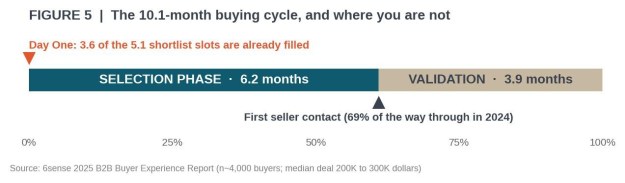
One number in that table deserves its own sentence. When buyers had ranked their shortlist in advance, the first vendor they called won roughly 80% of the time. In the rare cases where they had not ranked it, the first vendor called won just 57%. Talking first does not make you the favorite. Being the favorite makes you the first call.
Follow One RFP Backward
Take a single requirements document apart and the chain is short. Three hops, and you are standing at a page a stranger published while you were busy closing last year’s quarter.
| Hop | Artifact | Timing | What it decided |
|---|---|---|---|
| 0 | The RFP: 42 weighted requirements, five vendors invited | Day zero | Rubric locked. Weights assigned. Your bid is now arithmetic. |
| 1 | The assistant’s answer to “what should we evaluate in this category” | Three days earlier | Nine of the 42 requirements traceable, near verbatim, to this output |
| 2 | The handful of sources retrieved live to build that answer | Seconds earlier | A third-party roundup, two review-platform category pages, one vendor homepage |
| 3 | The roundup itself, written and last refreshed by an outside publisher | Eleven months earlier | Supplied the category vocabulary. Cost to produce: one writer-week. |
TABLE 2 | The composite trace of a single enterprise software RFP, reconstructed hop by hop.
The buying cycle now averages 10.1 months, down from 11.3. A page needs roughly two to eight weeks after indexing to start appearing in retrieval, and comparison pages often move inside 14 days. Add the two together and the intervention window opens about eleven months before the RFP lands. That is the whole thesis. The document you are reading was written to tell you where to stand in month one.
What the Machine Actually Reads
Vendors keep polishing the wrong surface. Assistants answering commercial questions run a live retrieval step and synthesize whatever comes back, and what comes back is overwhelmingly other people’s pages about you.
| Finding | Figure | Study |
|---|---|---|
| “Best X” listicles as a share of page types ChatGPT cites | 43.8% | Ahrefs, 26,283 source URLs |
| Commercial-investigation answers leaning on at least one list post | 100% | AIVO Research, 138 queries |
| Branded-query citations to reviews, listicles and forums (12% to product pages) | 57% | Omniscient Digital, 23,387 citations |
| ChatGPT’s most-cited pages with zero Google organic visibility | 28.3% | Ahrefs |
| AI Overview citations coming from outside Google’s top 10 results | 62% | Reported early 2026 |
TABLE 3 | Third-party pages are the retrieval layer. Your website is a minority shareholder.
The multipliers are the actionable part. Review-platform presence roughly triples average citations, and nineteen or more discrete statistics on a page nearly doubles them against a thin one. Density of verifiable numbers is a retrieval feature, which is a strange and wonderful thing for anyone who has ever been told to cut the data and tell more stories.
Ferrari Showed Up Two Seasons Late
Ferrari North America turned down the production’s request for real cars. So Miami Vice bought two Corvette-based Daytona Spyder replicas for about $49,000 each and put them on television every Friday night for two full seasons. Sonny Crockett’s black Ferrari became one of the most recognized vehicles on the planet, and it was a kit car.
By the time Enzo Ferrari’s lawyers took an interest, the category position was occupied. The settlement is instructive: Ferrari donated two 1986 Testarossas, and the replica had to be blown up on screen in the season three episode “When Irish Eyes Are Crying.” That is the price of arriving after the criteria are set. You do not buy a slot. You buy out the incumbent, on their terms, with a rocket launcher.
One more detail worth the airfare. The donated Testarossas arrived black, and Mann had them repainted white so they would read on camera in Miami’s night scenes. The car did not change. Its legibility to the medium changed. Nearly every vendor reading this has a real differentiator sitting in a PDF, in a black car, at night. The machine cannot see it.
Run the Numbers on Doing Nothing
| The response side of the business | Figure | Source |
|---|---|---|
| RFPs the average organization submits per year | 166 | Loopio, 1,500+ teams, 2026 |
| Hours the average team spends on a single response | 33 | Loopio (39 at enterprise) |
| Current average win rate | 39% | Loopio (45% since 2019) |
| Share of company revenue influenced by RFPs | 30–40% | Loopio, steady since 2019 |
| Losses that teams attribute to proposal quality | 13% | Loopio |
| Losses attributed to price and competition | 55–61% | Loopio |
TABLE 4 | 166 bids, 33 hours each, and only 13% of losses blamed on the thing you spent them writing.
That is roughly 5,478 hours a year of response labor, and the teams doing the work say the response is almost never why they lost. They lost on price and competition, which is another way of saying they lost on the criteria. You cannot out-write a rubric that scores you on features you do not lead with. One page, one writer-week, published eleven months earlier, beats a 5,478-hour habit.
The Eleven-Month Play, in Order
- Audit the prompts, not the keywords. Run the twenty questions a buyer would actually type and log every source retrieved. Buyers lead with commercial intent: 33% open with a category search, 31% with a competitor search.
- Find the criterion you own and check whether it exists in writing anywhere you did not publish. If it does not appear on a third-party page, it does not exist to the model, which means it will not appear in a requirements list.
- Get the page written by somebody else. Earned coverage outperforms brand-owned content by a wide margin, and a University of Toronto study found that preference to be structural. Your own “best of” list, with you at number one, is the beige suit in the pastel show.
- Fill the review platforms before the quarter you need them. Domains absent from G2, Capterra and Trustpilot average 1.8 citations; listed domains average 4.6 to 6.3. G2’s portfolio now commands roughly 84% of review-platform citations.
- Load the page with numbers. Pages with 19 or more data points averaged 5.4 citations against 2.8 for sparse pages. Sections of 120 to 180 words between headings averaged 4.6 against 2.7.
- Refresh on a calendar, because citations rot. Median half-life across 3.5 million citation events is 4.5 weeks, and ChatGPT churns fastest at 3.4. A URL cited today has roughly a 15% chance of surviving three weeks. Publish in bursts and you go dark in the gaps.
- Change the metric on the wall. Report shortlist placement and criterion presence, not leads. 95% of RFP teams track win rate; top performers track what happens upstream of it.
Tartikoff’s memo was two words and it dictated five seasons of casting, wardrobe, music budgets and car chases. The requirements document in your next RFP was assembled the same way, out of language that already existed, by somebody working fast. Spend 33 more hours arguing with it, or spend a week, eleven months earlier, making sure the language includes you. One of those is a rocket launcher. The other is a page.
Sources: 6sense 2025 B2B Buyer Experience Report (n≈4,000); G2, The Answer Economy, April 2026 (n=1,076); Responsive, Inside the Buyer’s Mind (n=350); Loopio 7th Annual RFP Response Trends & Benchmarks (1,500+ teams); Ahrefs AI search studies (1B+ data points; 26,283 source URLs); SE Ranking (129,000 domains, 216,524 pages); Omniscient Digital (23,387 citations); Scrunch/Stacker (3.5M citation events); Wix; AIVO Research; Forrester, 2025.

Discover more from 1000 Startups
Subscribe to get the latest posts sent to your email.

Claude Penland builds the marketing and business strategy for companies that are good at what they do and hard to find. Thirty years operating, one exit, eight of them as a practicing casualty actuary.
The free two-page read is genuinely free. Email claude@1000startups.com and I'll send back what I can see from the outside. Or see the work samples and how to work with me.
Pingback: The Commodity Phrase Index
Pingback: The Category You Named Is a Word No One Has Read
Pingback: Publish the Price
Pingback: Publish a Number You Could Lose